

This article contains my technical opinions and is for general information purposes only. Product references are generic as different brands and products may have different features.
Why Vertical Installations Demand Special Attention
In certain situations, vertical cable runs in high-rise buildings, wind towers, mining shafts, and industrial facilities must support their own weight while maintaining electrical integrity over decades. Improper design can lead to conductor movement, insulation stress, or premature failure; these are all safety risk and relevant codes must be followed, for example Table 21 in the CEC and subsequent notes discuss this topic. Please consult your local inspection authority for interpretation.
Construction and Design Features
Cables suitable for long vertical runs are designed to prevent internal (conductor) slippage caused by gravity, as this is the common failure mode in these applications. Special constructions may include filled cores, internal gripping layers, and armouring systems that lock the cable components together so the conductors cannot slide downward over time due to its own weight.
These features allow straight vertical installation without offsets or horizontal relief sections, making them ideal for shafts, towers, and mines. The diagram illustrates one option of how layered construction, outer jacket, armour, gripping inner jacket, insulation, and conductors, work together to provide mechanical stability in vertical installations.
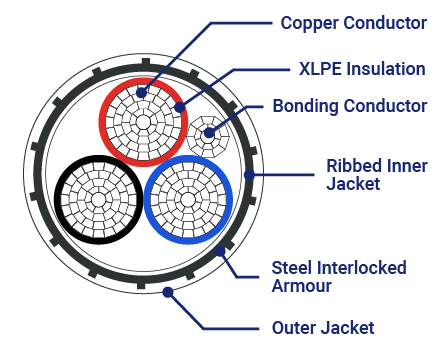
Comparing Vertical Cable Solutions

Applications
Vertical applications of cable without special cables can safely be completed but require careful planning, additional supports, and adherence to code approved methods. The vertical applications below can result in environments where these specific vertical cables are used.
Vertical Cable Applications, include:
- Electrical risers in tall buildings
- Cable trays across multiple floors
- Elevator and service shafts
- Wind turbine towers
- Boreholes and mining operations
- Industrial structures
Extreme Vertical Runs: Engineering Matters
Applications such as mining shafts and deep boreholes may require cables to support their own weight over very long distances. Engineers must evaluate self‑supporting limits and may require additional support systems such as messenger wires, cleats, or basket grips. Manufacturing tolerances can cause actual cable diameters to differ from nominal values. Verifying dimensions before selecting cleats or supports can prevent delays and ensure proper fit.
Summary
Vertical cable installations require careful consideration of many factors; some of which include mechanical forces, cable construction, support methods, and installation conditions that differ significantly from horizontal runs. In addition to meeting electrical requirements, cables must safely withstand their own weight over long distances without internal movement, deformation, or damage to insulation and terminations.
Choosing the appropriate solution during the design phase can improve safety, reduce installation challenges, minimize risk of premature failure, and enhance overall project efficiency. For complex or unusual vertical applications, consultation with experienced cable specialists can help ensure the selected approach delivers reliable performance throughout the system’s service life. These cables are a long lead item as they are built to order, as such please reach out for more information.
About the Author

Julian Godoy, Application Sales Engineer B.Sc. Eng., has 10 years of technical construction experience gained through major industrial, infrastructure, and commercial projects across North America. Julian is passionate about sharing his knowledge on better and safer cable installations.
He can be reached by phone at 604-977-9880 or via email at Julian.Godoy@texcan.com.


